
Sri Lanka: A Moral Dilemma at Sea
Updated: Mar 11

Nearly everyone who has been to Sri Lanka mentions the friendliness of the “locals” in the first breath. But precisely, what is a “local?”
Following a civil war that lasted nearly 30 years between the Tamil Tigers (an extremist rebel group in the north and descendants from India’s Tamil Nadu) and the Sinhalese (descendants from the settlers who immigrated to the island circa 543 BC), Sri Lankans are exquisitely sensitive to cultural labels. My quest for political correctness is further complicated by the fact that Sri Lanka changed its name from Ceylon 25 years after it gained independence from British rule; somewhat akin to a woman returning to her maiden name following a divorce. And though it is acceptable to call someone from Sri Lanka a “Sri Lankan,” many of the older generation also go by “Ceylonese.”
For the linguists at heart Sri Lanka means “resplendent island,” and I would have to agree. But for the purposes of this article the only name you need to know is Roshan, which means “shining light” in Sanskrit.
My “shining light “meets me at the airport after a three-and-a-half-hour flight from Delhi, India aboard “Screaming Baby Express.” Unbeknownst to me, my travel date coincides with the end of Diwali, India’s largest festival. The day after Diwali is like the Wednesday before Thanksgiving except the US is a country of less than 400 million, and India is another 1 billion more. Navigating the airport was the purview of the very brave (and the very stupid). I arrived at Sri Lanka’s Colombo Airport decidedly a bit worse for wear but there was Roshan with a bouquet of flowers larger than I carried at my wedding —bless him.
Roshan is of Sinhalese descent and a Buddhist. Despite numerous attempts I have failed miserably at meditation, yet Roshan seems to exude its purported benefits; he is sweet, gentle, and thoughtful beyond compare. Although I can’t help but wonder if I won’t put his patience to the test— we will spend the next ten days together practically glued at the hip. It’s not uncommon for people who otherwise delight in each other’s company to implode while traveling. Jerry Seinfeld summed it up best when he described traveling with his wife was like spending $500/night to argue in a strange hotel.
By contrast, Roshan and I are at an advantage having not spent years being exasperated by the other’s idiosyncrasies.
It’s almost 11 pm by the time I reach my hotel and Roshan explains to the hotel clerk that I am a “VIP” (Where does that come from?) and I need a quiet room. (Okay, that part is true.)
“What time I come get you tomorrow to see the pish men [sic]?” Roshan asks.
???
It is an observation and not a criticism that Roshan switches the pronunciation of “f ” to “p.” My tour officially begins tomorrow morning with a visit to the fishermen. However, because I have just spent five days surviving Diwali, I am anxious to get a quiet night’s rest. Although Diwali celebrates the triumph of goodness over evil and freedom from spiritual darkness, the less publicized reality is that Diwali is a 5-day firecracker extravaganza. Soon after dawn, children barely old enough to walk begin setting off “crackers” that sound like gunfire. They squeal with delight as these maniacal strips explode like Whack-a-Mole for pyros. The full-on firework displays are saved for nighttime and end around 1 am — but not always.
I am ready to finally embrace a night of rest and ask Roshan to meet me at 8:30 am. I am equal parts excited and exhausted.

For geographical reference, Sri Lanka hangs off the southeast coast of India like a drop of wax. At a distance of 800 miles, it is often referred to as the “teardrop of India,” yet it is closer to the equator at just 500 miles. The first morning I wake up in this new country, I feel as if I am no more than a stone’s throw away from the sun. “Bloody hot” is a polite description. In reality (and coming from Maine), I figure I can last about six minutes without succumbing to heat stroke or insanity, even the metal frame on my camera lens is hot to the touch.
Roshan is early for our meeting (again, bless him) and quickly clasps both my hands in his and momentarily holds them to his forehead. It feels perilously close to the proverbial “kissing of the papal ring” except Roshan’s blessing feels infinitely more powerful to the God of my understanding.
“You have good sleep, M’dam?”
“Yes, and you?”
“Very good M’dam. I want you sleep well and be happy.”
I consider asking if he could “turn down the sun” but I suspect this won’t translate easily so I just nod and tell him I am vey happy. I also resist the urge to say, “Let’s go to the pish market!”
Contrary to most tourists, I had opted not to stay in Colombo, Sri Lanka’s capital, it holds few attractions for my level of “local” interest. Instead, I am in Negembo (nee-gam-BO), about 30 miles north. Unlike the city with its plethora of Marriott and Hyatt style hotels, Negembo feels like a blend of jungle and 3-star comfort. There is the standard complement of street dogs, tuk-tuks, and motorcycles that manage to navigate in relative harmony, and they do so with a modicum of honking.
I can tell I’m going to like Sri Lanka.

Up until now, the largest fish market I have visited was at Maroansetra in northern Madagascar. By “large,” I am referring to the size of the boat relative to the number of fish, and humans. Maroansetra pales in comparison to Negembo which has a robust, small fishing boat industry dominated by boats that set out soon after midnight and typically return by mid-morning. The daily catch is taken to the adjoining market and what doesn’t sell immediately is spread on plastic tarps to dry before the rains come, often starting as early as noon.

Sometimes I wonder if my nose is broken, or, to be more precise, my sense of smell. There are no less than three million fish of varying sizes (and states of decay), which should equate to an aroma worse than a cat food factory. Instead, I find it tolerably unpleasant and not terribly memorable. What does gives me a pause is the sheer amount of labor taking place under the blistering sun, men walking about in tandem with a wooden pole hoisted over their shoulders and heavy buckets laden with fish hanging below. They are weaving about in all directions stepping around the maze of tarps and mountains of fish guts. Although I am quick to start taking pictures, I am even quicker to make sure I am not standing in anyone’s way. For reasons I can’t immediately discern, some men keep their body covered as if their dermatologist was following them on a spy-cam, while others have very little covered at all.

Roshan offers to walk beside me holding an umbrella over my head for protection, but I politely refuse. I have already basted myself in SPF 50 because my dermatologist is beginning to feel like my “significant other.” I also suspect I won’t be out in the sun for very long, my eyes are already stinging from the dripping sweat. Yet, I am fascinated with every stage of the process, from watching how they drive a boat at full throttle onto the beach, hoisting the engine out of the water at the last millisecond to the women standing over, bent like hairpin, flipping thousands of fish over one-by-one as they bake in the sun.

In this part of the world, being a fisherman is a sweaty, grueling business but it is also like a phoenix from the sea. The tsunami that struck Sri Lanka the day after Christmas in 2004 killed at least 46,000 people—7,500 were fisherman and another 5,600 were never found. The government provided funding for families to rebuild their homes outside the tsunami zone, but they weren’t interested, claiming they can’t live if they can’t hear the water. Roshan and I walk past rows of one and two-room houses. They are less than a hundred yards from the high tide mark. They have made their choice.

“Now, M’dam, we will go on boat safari. I have already called the driver and he is waiting.”
I don’t recall seeing a “boat safari” on my itinerary. After all, my mission is about wild fibers albeit with a few detours.
The boat safari was just a ten-minute drive, not including a brief stop outside the prison (definitely, not on the itinerary), to witness a queue of family and friends waiting outside the prison gate. Roshan explains the prison system is very corrupt. Apparently, even petty criminals are thrown into jail forcing families to borrow huge sums to pay a lawyer who can get them out — or pay off the prison guards—or both. It is one of the few negative things Roshan says about his beloved country.
In hindsight, I'm thankful I didn’t know about the boat safari, or I might have conjured something quite different from the reality.
Roshan parks the car in a bed of weeds and litter. In front of us, tied up along something that sort of resembles a dock —if all the planks were in place —is a boat that no rational person would step aboard. But there is a friendly “local” beckoning me to come forward, offering his hand as I try not to fall through the cracks.
“You are VIP, so I arrange special boat safari for you.”
I don’t know how I’m going to get Roshan to quit referring to me as a “VIP,” but it needs to stop.

We motor our way through the lagoon passing herons perched atop mooring posts and hundreds of fishing boats much larger than the ones by the market at the beach. These boats service the wholesale market. They are brightly painted, or, more accurately, were once brightly painted. They go out for weeks at a time, but because the fish stocks around Sri Lanka are being depleted, they are now also the source of Sri Lanka's growing trade in illegal fishing in foreign waters. Recently, a fisherman was caught in the Seychelles and was fined 2.5 million Seychelles rupees (about $174,000 US). Unable to afford the fine, he was sentenced to two years in prison.
The fishermen know they are risking jail time, but the risk outweighs the benefits.

I sit down on a well-worn plastic seat inside the boat. The warm breeze feels good against my salted cheeks as we slowly motor along. It is also blissfully quiet. I am tempted to ask Roshan what animals we are looking for on our safari but decide to say silent and enjoy the ride. Roshan and the captain joke back and forth in Sinhalese; I am sure he is relieved to be conversing in his native tongue. Meanwhile, I try not to obsess about the fact that I doubt where we are going anywhere with a connection to wild fibers. Instead, I silently marvel at the fact that I am in Sri Lanka.
How blessed am I.
We travel along for maybe 30 minutes when the captain eases the boat into shallow waters and pulls the engine. We are surrounded by mangroves and clear, blue water. I want to shout out, “Why are we stopping?” which, in terms of annoyance, is second only to “Are we there yet?” The captain proceeds to take two plastic chairs from the stern, and places them in the water. Next, he take three plastic tables and sets them in front of the chairs. I am beginning to connect the dots when Roshan turns to me with a huge smile and announces, “M’dam, please get out. We will enjoy fin’apel here.”
Fin’apel? I am befuddled until I see the captain carrying a tray with a watermelon and a pineapple, which he effortlessly hacks open with a machete, using the boat's bow as his cutting board. Soon, Roshan and I are sitting on our Walmart style chairs (sunk ten inches into the water) with fruit juice dribbling off our chins.
Roshan is beaming, “This is VIP boat safari.”
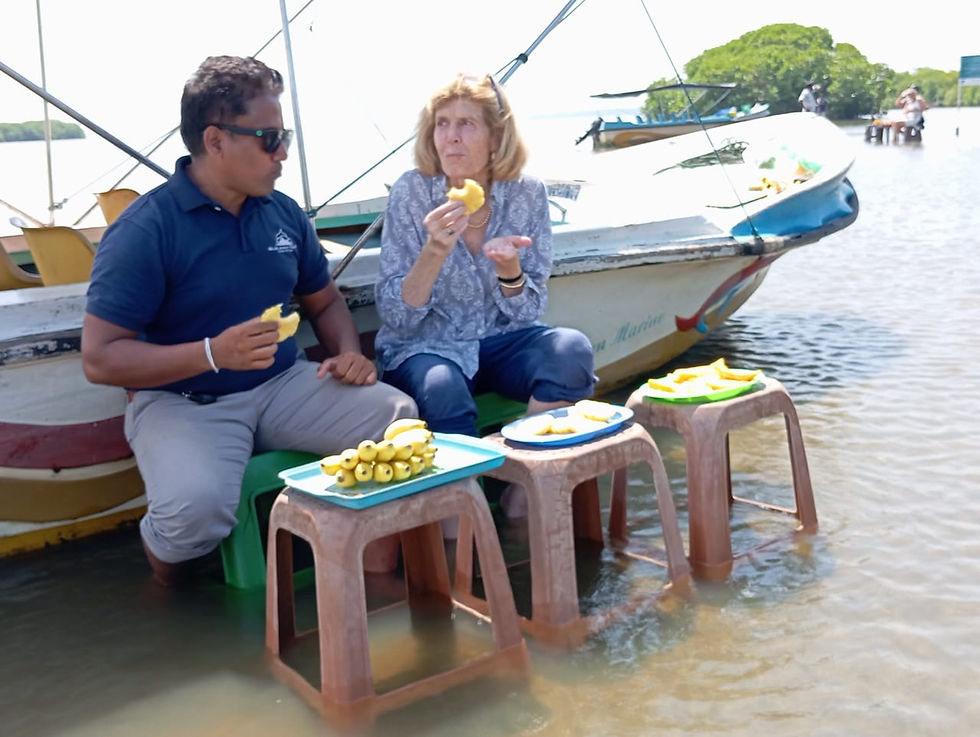
On previous safaris, we typically stop for coffee and biscuits in the morning or sundowners in the late afternoon only after several hours of bouncing about the jungle searching for wildlife. Somehow, eating before the animal sighting seems contrary to the norm but I am brand new to Sri Lanka and its traditions, and isn’t that what travel is all about … discovering things that are different?
Eventually, the plastic chairs are set back in the boat, and we take off with the bow still covered in rinds and banana peels. The idea of littering the lagoon with errant fruit scraps as we gain speed gives a hard yank on my sense of environmental responsibility. I contemplate offering to scoop them up and put them in the small plastic bag reserved for trash but pause, I don’t have a keen enough sense yet as to what may inadvertently cause offense. But which is worse, offending Roshan or Mother Nature?
Moments later, our bow noses directly under the hanging branches of a teeny tiny island and a frenzy of monkeys jumps on board, frantically grabbing and gulping every last little scrap. Quickly, I reach for my camera and begin firing when my battery dies.
By the time I replace it the buffet is gone —and so is my moral dilemma.

As we turn around and head back to the dilapidated dock. I sense the monkeys represent the animal portion of my safari experience, which is fine. I just need to remember that all words don’t mean the same thing everywhere you go. Like “knickers” to the English, referring to your panties, not pants that stop at the knee —it's an important distinction.
As predicted, the rains have started, and on the drive back to the hotel I can’t help but think of how desperately wrong I was about my expectations of Sri Lanka. Its proximity to India, along with a large population of Indian descendants, led me to imagine this “resplendent island” would be like a mini-India, but it isn’t. The congestion of tuk-tuks and street dogs and beautiful, brown-colored people all look very similar on the surface, but the lack of honking is notably absent. When Roshan finally does use the horn with a single tap I ask, “Why now?”
“You see, M’dam, I tap once so the driver knows I am passing. He taps back to say, ‘I see you.’ I then tap twice to say, ‘Thank you.’”
This quick cacophony is a conversation unto itself. I don’t know if can ever recall a time when someone honked at me out of thanks. Clearly, when people refer to the friendliness of the Sri Lankans, it includes their driving etiquette as well.
Roshan drops me off at the hotel and tells me to message him if I need anything … anything. I know he means it. We will leave at 8 am the next morning for the weaving factory and village. Although I have enjoyed the morning’s adventures, I will feel better when I get back to work. As I begin walking to my room, Roshan once again grasps both of my hands and holds them to his forehead. He smiles at me ever so sweetly and says, “Please, M’dam, take a good rest.”
My heart is melting — and it is not from the sun.


Comments