
A Remarkable Voyage from Marine Life to Merino Life
Rachel Ives is deeply connected to water. In fact, “deep water” is not only how her parents met fifty years ago on the shores of Foula, a tiny island west of mainland Shetland, but deep-water treasures have sustained her family ever since.
Then the tide turned.
Suddenly, water was no longer the veritable giver of life. It had become brown. And bad.
When Rachel picks me up from my hotel in Dundee, Scotland, I have no idea just how extraordinary her farming journey has been. She drives a well-loved blue farm truck. Lass, a semi-neurotic Border Collie, ricochets around the back seat, desperately trying to herd the oncoming traffic. Tucked beside her is a crate of milk bottles fitted with rubber nipples for feeding a handful of bum lambs.
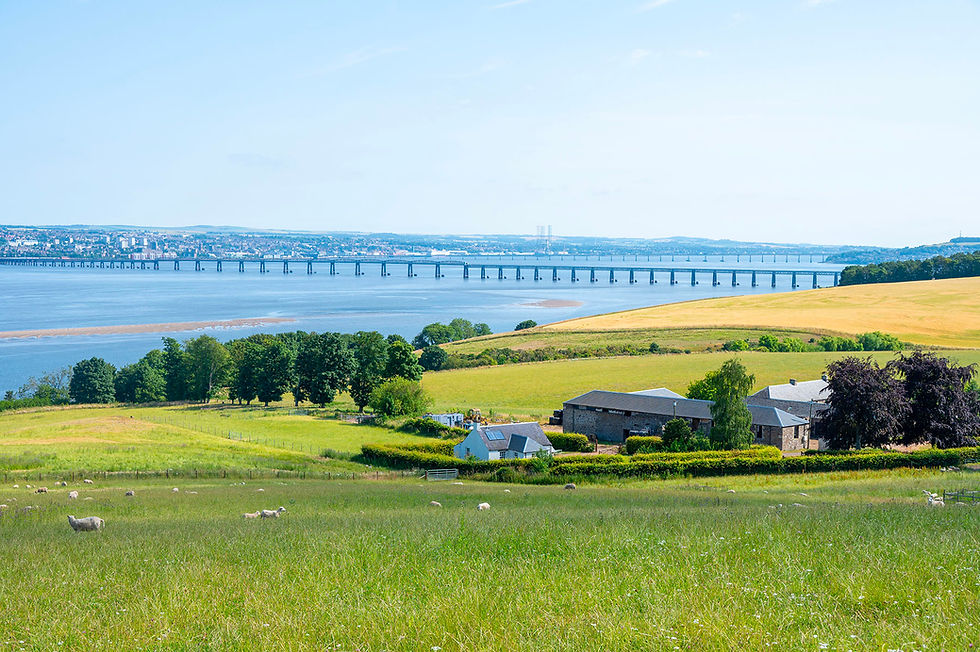
I’ve met my share of farmers, and by every appearance Rachel is the real deal. She raises sheep and cattle on Kilburns Farm in Fife, often referred to as the Kingdom of Fife. Most people associate the county with St Andrews—the Bethlehem of golf—but Rachel’s home is the nearby village of Balmerino.
Perhaps it is simply my tendency to view the world through a woolly lens, but I couldn’t help assuming the village’s name must somehow be connected to sheep. Historically, however, Merinos and Scotland have never gotten along—and, by coincidence, that, too, is a water thing.
Scotland’s famously damp climate and rugged Highlands are far better suited to hardy breeds such as Cheviots and Scottish Blackfaces than to fine-wooled Merinos. Centuries ago, farmers discovered they could graze three Cheviots on the same acreage needed for a single Merino. Moisture was simply too great a liability for the Spanish breed—an ironic fate for sheep that once occupied a geopolitical position not unlike today’s oil-producing nations.
As it turns out, Rachel’s hometown has nothing to do with sheep at all.
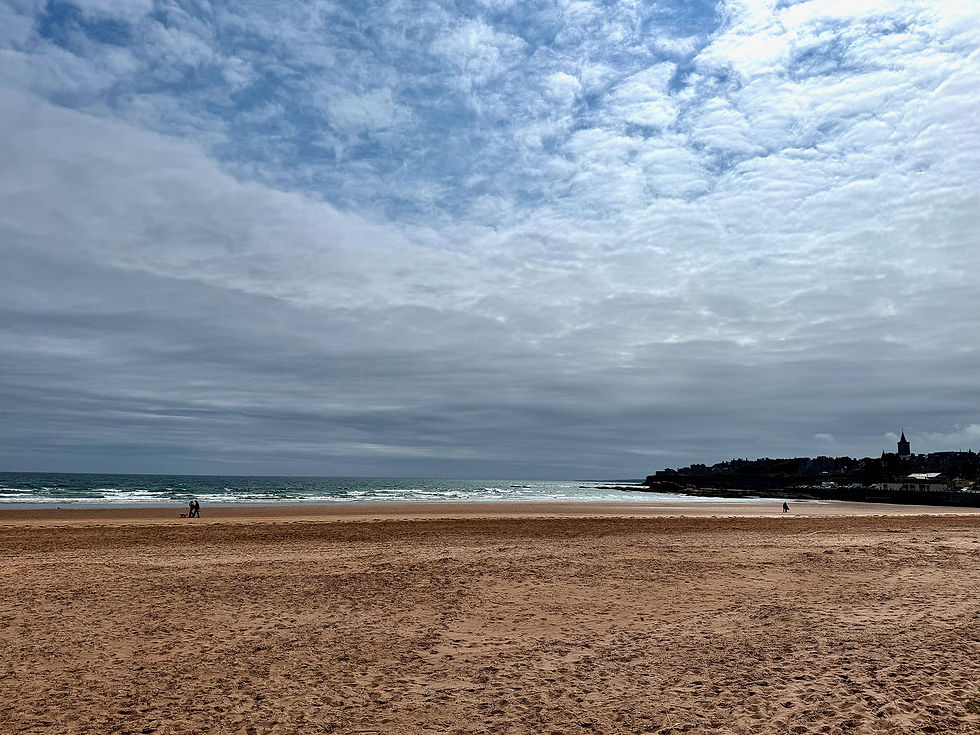
Balmerino derives from the Scottish Gaelic Baile Mheana, meaning “town of the sea.” The origin of Merino, on the other hand, remains something of a historical mystery. Many scholars trace it to the Marinid dynasty, the Berber rulers of medieval Morocco from whom the Spanish Merino’s ancestors may have originated. Others suggest it comes from medieval Castile, where a merino was a royal official responsible for administering local laws, including the oversight of sheep.
I decide it would be wise not to confuse my shaky understanding of either Gaelic or Castilian history.
The twenty-minute drive to Kilburns Farm begins by crossing the Tay Bridge. Stretching nearly two miles, it was the longest bridge in the world when it opened to railway traffic in 1878. Just eighteen months later, it collapsed during a violent storm as a train crossed, killing all seventy-five people aboard.
For a few moments, our conversation shifts from raising sheep to raging seas, and Rachel casually mentions her father and the Titanic. Her roots in the deep begin to surface, along with the story behind the remarkable transformation of Kilburns Farm.
Despite the truck, the Border Collie, and the lamb bottles, Rachel has not spent her life farming.
Instead, she followed both of her parents into the family’s marine salvage business, joining an elite group of divers who descend into the ocean’s depths in search of shipwrecks and their hidden bounty. Maritime salvage law is a curious blend of legal precedent and “finders, keepers.” Depending on what lies beneath the waves, the rewards can be considerable.

To be clear, Rachel’s father, Alec Crawford, did not plunder the Titanic. He was, however, among the first divers to successfully explore the wreck of the Oceanic, a transatlantic luxury liner that struck a big, bad reef off Foula in 1914. After lying broken on her side for two weeks, the notoriously powerful currents finally dragged the ship beneath the surface. Decades later, Crawford and his diving partner decided to take their chances against those same currents to see what remained.
In hindsight, youthful confidence probably played as much of a role as experience. Then again, some risks do pay off.
When Rachel came of age, she worked in salvage herself, a career that took her around the world. She might still have been working at sea had she not fallen in love while working on the recovery of the ill-fated Costa Concordia off the coast of Italy. Motherhood and shipwrecks do not pair well on the same plate, and before long Rachel found herself at home with three young children.
Who knows how her path would have changed had she not noticed something unsettling one day: the water flowing from her tap had a brownish tinge. In a career focused on solving problems undersea, now her problem was underground.
I nod politely at Rachel’s dilemma before understanding the true scope of the problem.
Adjacent to Rachel’s property is a commercial farm. Thousands of acres devoted to growing grains, potatoes, and vegetables destined for Tesco, one of Britain’s largest supermarket chains, where a fleet of combines could rival the price of a midsize cruise ship. The road to Kilburns cuts directly through the land.
As we drive through the heart of the operation, the oncoming traffic disappears and even Lass settles down for a few minutes. The endless expanse of green crops is undeniably more attractive than asphalt and skyscrapers, yet it bears little resemblance to the romantic image most people have of the Scottish countryside as the rooftops of enormous pig and poultry barns come into view.
This is the reality of most everyone’s farm-to-table experience, driven by high consumer demand at affordable prices.
For years, Kilburns had been a terrestrial accomplice. And then, the lease was canceled. The combines disappeared. The water cleared.
With the fields at her doorstep, Rachel now had the opportunity to work outside whilst raising a young family. The sheep and cattle began arriving and a new chapter—for both man and animal—had begun.

By the time Rachel’s Merinos come into view, I forget the heavy machinery. Lass has leapt from the truck to gather sheep while Rachel reaches for the lamb bottles. A handful of hungry ram lambs race toward the fence. I’m left trying to balance a large Nikon camera in one hand while feeding an impatient lamb with the other.
Had I been standing at this same fence a decade earlier, there would have been no lambs to feed.
Scotland hardly suffers from a shortage of sheep. More than 6.5 million are spread across some 18,000 farms. Merinos, however, are so rare that no official census exists, and there isn’t even a breed society devoted to them.
During my research I discovered, much to my horror, that someone had also christened a breed of guinea pigs “Merino guinea pigs.” They are merely one of several long-haired guinea pig varieties, alongside Texels.
Surely some higher authority other than an arthritic journalist/retired farmer should be policing these things?
I say that with love in my heart as someone whose own childhood home was once overrun with hairy piggies after Scooter—our hopelessly oversexed male—wasn’t removed from Scamper, his underage companion, in time. In case you ever need a fuzzy fact for your next dinner party, guinea pigs are capable of becoming pregnant again just two hours after giving birth.
Back to the sheep.

When Rachel assumed management of Kilburns Farm, her goal was to transform former cropland into a biodiverse landscape capable of supporting organically raised livestock. The process began, appropriately enough, beneath her feet. Comprehensive soil surveys examined everything from soil structure to earthworm populations.
Whether the goal is delicious beef, perfect potatoes, or exceptionally fine wool, it is still a dirty process.
Based on those surveys, half the farm’s arable acreage was replanted with a diverse herbal ley containing sixteen different species of grasses, herbs, and legumes.
As we walk through one of the pastures, my attention remains fixed on the sheep while Rachel repeatedly bends down to point out individual plants. Different species of clover naturally capture nitrogen from the atmosphere, enriching the soil while eliminating the need for synthetic fertilizer. Since converting to regenerative agriculture, Rachel hasn’t purchased any. She has also planted chicory— a natural de-wormer—again, another expense avoided. Not only does happy soil help reduce operating costs, but it also makes for happy insects. The birdlife on Kilburns Farm is now thriving as well.
Healthy soil does more than save money. It feeds insects, which in turn feed birds.
“I love hearing the curlews,” Rachel says as we edge closer to the flock, fully expecting them to bolt the moment I raise my camera.
Curlews have declined by roughly fifty percent across the United Kingdom over the past two decades as agricultural practices have intensified. Their haunting, bubbling calls are as much a part of the countryside as winding roads and neatly clipped hedgerows. The RSPB (Royal Society for the Protection of Birds) has launched a national effort to help save this endemic bird by promoting farming practices that are in balance with nature. Perhaps it is already on your calendar, but April 21 is World Curlew Day.
Rachel’s decision to raise Merinos came from an unlikely source—her mother.
As a studied knitter, she recognized that Scottish knitters had little access to locally produced fine wool. But one obvious question remained: if Merinos struggled so badly in Scotland two centuries ago, why could they thrive today?
The answer can be summed up in two words:
Leslie Prior.
Several years ago I had the privilege of visiting Leslie’s farm, Devon Fine Fibres, in England. Leslie became Britain’s leading cashmere goat breeder, another animal traditionally ill-suited to Britain’s wet climate. However, she also had a side gig improving the Bowmont, a Merino-style first cousin, bred from a Shetland and Saxon Merino cross.
Leslie is the model of genetic diligence. After repeated trips to Australia to import carefully selected bloodlines, British farmers finally gained access to Merino genetics better adapted to wetter conditions while retaining the breed’s prized fine white fleece.
Rachel didn’t purchase her sheep directly from Leslie, but Bowmont genetics almost certainly graze these pastures today. She wisely—and quite serendipitously—trademarked her yarn as Balmerino™, acknowledging that it comes from carefully bred Merino crosses rather than purebred Merinos.
I am delighted that Balmerino has finally found its woolly identity, but perhaps no one is happier than renowned Scottish knitwear designer (and judge on the Game of Wool), Di Gilpin. Working with Laxtons Mill, she has transformed Rachel’s Balmerino™ fleece into an exceptional range of colorful, distinctly Scottish yarns.
The yarn has also placed Kilburns Farm firmly on Scotland’s growing network of yarn crawls.
Unlike many farms, which attempt to host yarn gatherings in a semi-clean section of the barn, or huddled under an outbuilding, Rachel hosts her gatherings in a large guesthouse that could just as easily accommodate an unruly frat party as a hive of rabid knitters.
But that isn’t the only benefit.

Standing in the middle of the driveway is what initially appears to be a prehistoric standing stone gone astray from Stonehenge. It is anything but. The towering monument is one of the Oceanic’s original brass propeller blades, weighing six and a half tons and still encrusted with decades of marine life.
Another propeller stands polished outside the Shetland Museum. I’ve walked past it at least half a dozen times without giving it much thought. I prefer the version at Kilburns. It still carries the scars—and the stories—of the sea.
Although Balmerino™ yarn has become an exciting new chapter for Kilburns Farm, Rachel’s commitment extends well beyond wool.
The farm is certified through Pasture for Life, a British organization recognizing meat, dairy, and fiber produced entirely from pasture and forage. At the top of the property, Dexter and Highland cattle browse happily through scrub and brush, quite unconcerned by my presence—unlike the sheep.
The farm’s beef and hogget boxes routinely sell out, a testament not only to their flavor but to the growing demand for food raised in harmony with nature.
The contrast between Kilburns and its neighbor could scarcely be greater. Yet one helped shape the other. Rachel transformed a troublesome situation into an opportunity that now benefits everything from insects and birds to knitters and diners.
Her journey from marine life to Merino life proves that there is more than one kind of treasure waiting to be recovered.
For more information, please visit: https://www.balmerino.co/


Comments